
What Is a Biometric Access Control System and When Does an Industrial Plant Need One?
A biometric access control system authorizes entry by verifying a physical trait of the person, such as a fingerprint, face or iris, instead of a card or code. An industrial plant needs it when it must guarantee who really enters critical zones, not just which credential is presented.
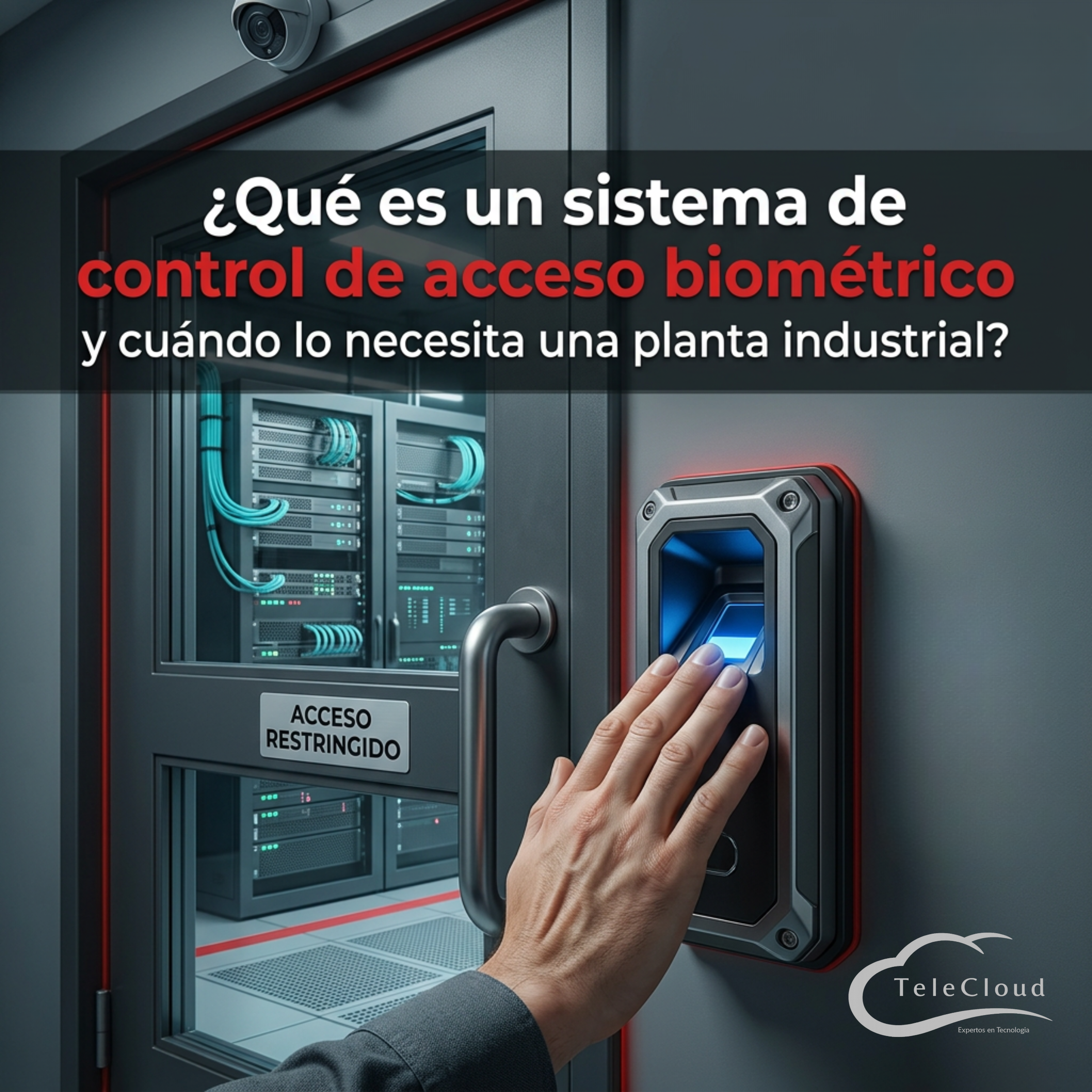
During an audit, a plant discovers that a former employee who left three months ago can still get in. Their access card was never deactivated, it is still active in the main door reader, and it worked without a problem when the auditor tested it. Nobody noticed because the card access system does not distinguish who presents the credential, it only verifies that the card is valid. A card can be lent, lost, cloned or left active after a termination, and in all four cases the door opens for someone who should not get through. That gap between the card and the person carrying it is exactly the problem biometric access control solves.
The Difference Between Validating a Credential and Verifying a Person
Traditional access control works with something the person carries or knows: a card, a proximity fob or a numeric code. The system verifies that the credential is valid and opens the door, with no way to confirm that whoever presents it is really its owner. Biometric access control changes the basis of that verification: instead of validating something the person carries, it verifies something the person is, a unique physical trait such as a fingerprint, face or iris. That difference is decisive in an industrial environment, because a card can pass from one hand to another and a biometric trait cannot. The system stops answering whether the credential is valid and starts answering who actually crossed the door.
The Four Security Gaps of a Card
A physical credential carries four vulnerabilities no card reader can solve on its own. The first is lending: a worker hands their card to another to register their entry or access a zone, and the system accepts it as if it were the authorized person. The second is loss or theft: a lost card works in any hand until someone reports it and deactivates it. The third is cloning: the simplest proximity credentials can be copied with accessible equipment. The fourth is the termination that was never executed, like the case of the former employee whose card stayed active. Biometrics closes all four gaps at the root, because it ties access to the person and not to an object that can circulate, be lost or be duplicated.
When an Industrial Plant Really Needs Biometrics
Critical Zones Where It Matters Exactly Who Entered
Not every door in a plant needs biometric control, and forcing it on low risk access points adds cost without proportional security. Biometrics is justified in the zones where it matters with certainty who entered and who did not: areas with dangerous machinery, laboratories, server rooms, warehouses of high value material or controlled substances, and zones subject to safety or traceability regulations. At those points, an access log that only proves which card was presented may not be enough before an audit, an incident investigation or a regulatory requirement. Biometrics delivers a log that ties each entry to a verified person, and that level of certainty is what makes it necessary at critical access points.
When Attendance Control Must Be Reliable
A second scenario where biometrics becomes necessary is attendance control. In an operation with many shifts and personnel, card entry logging is vulnerable to one worker clocking in another who arrived late or did not show up, a practice that distorts payroll and the control of hours worked. Biometrics removes that possibility, because it requires the physical presence of the person to register attendance. For a plant where precise control of hours and shifts has a direct impact on costs and labor compliance, that certainty in the log justifies the investment regardless of the perimeter security component.
What to Consider Before Implementing a Biometric System
Integration With the Rest of Security and the Network
A biometric system pays off more when it integrates with the rest of the plant security and network infrastructure, instead of operating as isolated equipment at each door. Integration allows a worker physical credential to be linked with their digital permissions, so that when someone leaves the organization, both their physical access and their access to systems are revoked at once, closing the former employee gap on both fronts. It also allows access events to be logged centrally, monitored and cross referenced with the video surveillance system. Access control connected to the network additionally requires that network to be well segmented, so the physical security devices do not become an entry door toward the critical systems of the plant.
Continuity When Power or Connection Fails
An access system controls doors, so its behavior in the face of a power or network failure must be defined from the design. The system has to resolve what happens to the doors if the power goes out, respecting both facility security and the evacuation routes required by civil protection regulations. That implies power backup at the critical access points and a defined operating mode for contingencies. A biometric control that leaves doors locked during a power outage can become a safety risk for people, and one that leaves them open cancels its function; the correct design resolves that balance before installation.
At TeleCloud we design and integrate access control systems, including biometric ones, together with CCTV and the network infrastructure that supports them, for companies in manufacturing, banking, government, hospitals, hotels and education. We have more than twenty years of experience, Cisco, Fortinet, Avaya and Huawei certifications, nationwide coverage from our base in Querétaro and certified support. We connect access control with the rest of your security and with a well segmented network, and we resolve continuity in the face of failures from the design. Learn about our approach at https://telecloud.com.mx
Frequently asked questions
Does biometrics completely replace access cards?
It does not always need to. In many plants both methods coexist: biometrics in the critical zones where verifying the person matters, and cards at low risk access points. They can even be combined, requiring a card plus biometric verification at the highest security points. The decision depends on the risk level of each access point.
What happens to my employees biometric data?
Handling biometric traits carries personal data protection responsibilities that must be defined from implementation: how they are stored, who accesses them and with what security measures. A well implemented system protects that information with the same rigor as any sensitive company data, and complies with applicable data protection regulations.
When is it worth moving to a biometric system?
It is worth it when your operation needs certainty about who enters a critical zone and card logging is no longer enough before an audit, an incident or a regulatory requirement; or when card attendance control is distorting payroll. More than a company size, the signal is the need to tie each access to a verified person.
Do you need a network diagnosis?
The TeleCloud team evaluates your current infrastructure and proposes solutions adapted to your industrial operation.
Schedule free diagnosis