
What Is an Industrial UPS and Why Can a Power Outage Paralyze Your Entire Operation?
An industrial UPS keeps electrical supply to your plant's critical equipment when the external grid fails. Without one, a three-second micro-outage can corrupt production cycles, damage data, and halt SCADA systems for hours.
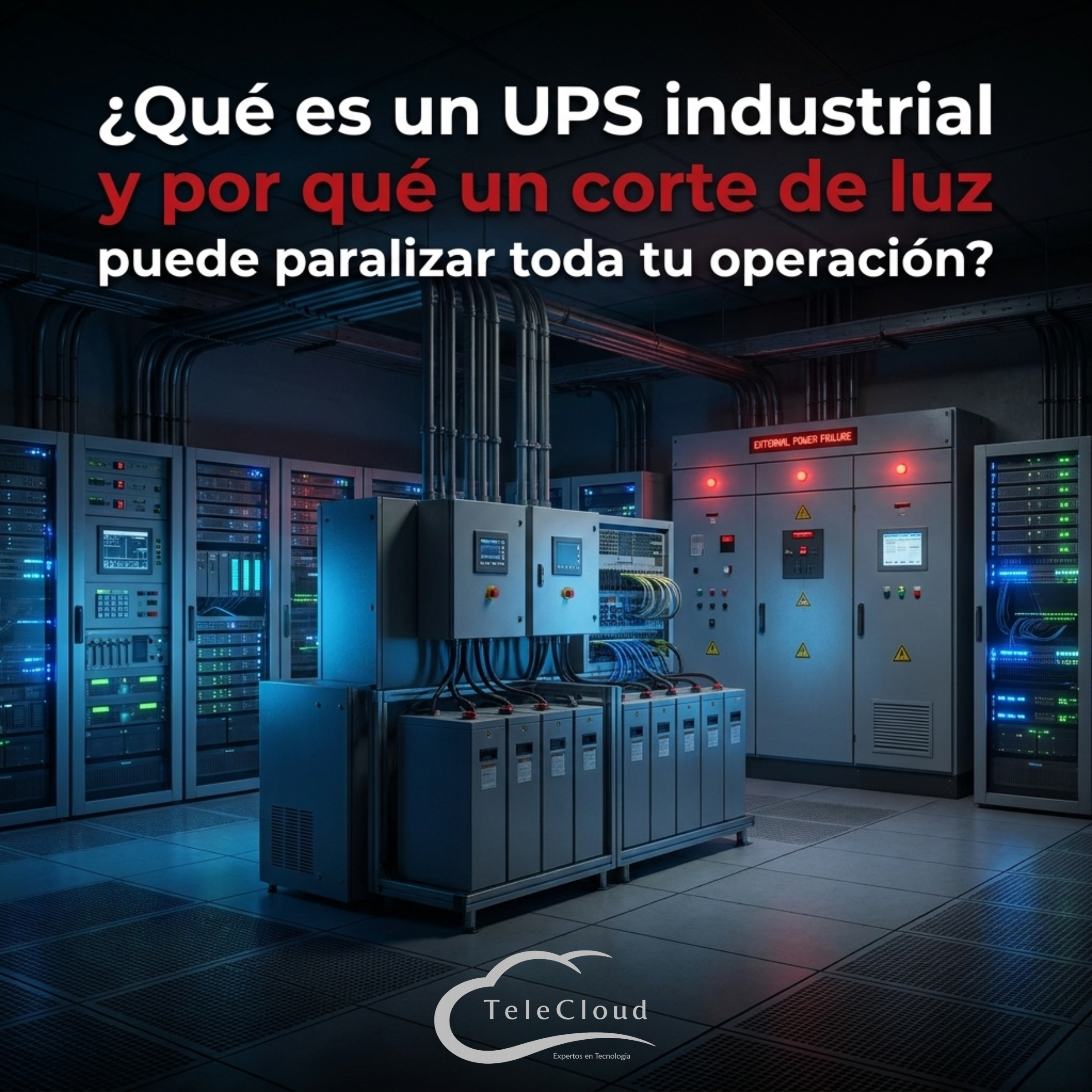
It is 2:47 in the morning when the maintenance team receives the alert: the control system on the heat treatment furnace has shut down without warning. The outage lasted less than three seconds — enough to corrupt the active cycle, render the batch of parts in process unusable, and trigger an alarm in the SCADA system that takes forty minutes to reinitialize. At dawn, the failure analysis reveals that the cause was not a machinery or process problem: it was a micro-outage on the municipal power grid. The plant had no uninterruptible power system sized for the current load in that production area.
An industrial UPS maintains the electrical supply to a plant's critical equipment when the external grid fails. Its absence compromises complete production cycles, process data accumulated during the shift, and the response capacity of the technical team at the worst possible moment.
The risk underestimated by plants that have not experienced a major outage
What happens in the first seconds without uninterruptible power
When the power grid fails without an online UPS system, digital control equipment loses power abruptly. A PLC that loses power mid-cycle does not save the process state; when it restarts, the system can end up in an undefined state requiring manual reinitialization and verification of every active parameter.
A production server without power backup that shuts down during a database write can generate record corruption. A SCADA system that loses power unexpectedly can take between 30 and 60 minutes to reinitialize completely, depending on the number of variables it manages and the state in which field devices were left.
The downtime generated by an unprotected outage is not measured only in the minutes of the outage itself: it is measured in the time required for diagnosis, system reinitialization, and process quality verification; and when the interrupted cycle involved materials in process, in the cost of the wasted batch.
Electrical events that are not outages but also destroy equipment
Most electrical incidents that damage plant equipment are not total blackouts. They are shorter-duration events of much higher frequency, and none of them are visible without specific instrumentation:
Micro-outages (less than 1 second): the most frequent and the ones that generate the greatest accumulated damage to control electronics. Sufficient to restart a controller or corrupt an active cycle.
Surges and spikes: generated by large motor startups, switching operations in the main panel, or atmospheric discharges. A voltage spike not absorbed by a protection system can damage the power supply of any equipment connected to that line.
Undervoltages (brownouts): voltage drop without total outage. Progressively degrades internal components of sensitive electronics without generating a visible alarm, until the equipment fails in an apparently inexplicable way.
Electrical noise and harmonics: generated by variable frequency drives, converters, and non-linear loads. They propagate through the electrical network and shorten the service life of electronic components continuously exposed to them.
A double-conversion UPS filters all these events before they reach the protected equipment, because the connected equipment operates permanently from the UPS battery.
How does an industrial UPS work and how does it differ from domestic equipment?
UPS topologies: what each one protects and which applies to industrial environments
The topology defines how the UPS manages energy between the electrical grid, the batteries, and the load. There are three main topologies and each offers a different level of protection:
1. Online (double conversion): The UPS converts alternating current to direct current to charge the batteries and back to alternating current to supply the load. The connected equipment operates permanently from the inverter output, with zero milliseconds of transfer time for any event on the grid. This is the correct topology for PLCs, production servers, and SCADA systems. It is the standard in critical industrial infrastructure projects.
2. Line-interactive: Keeps the battery in reserve and acts when it detects a failure. Transfer time is 4 to 6 milliseconds. Acceptable for communications equipment such as switches and routers; insufficient for process controllers.
3. Standby or offline: Acts only during a total outage and does not correct micro-outages, surges, or electrical noise. Suitable for low-criticality domestic equipment; insufficient for industrial environments of any kind.
What distinguishes an industrial UPS from domestic 220 V equipment?
Beyond topology, industrial UPS units differ from domestic equipment in four aspects that determine their viability in plant environments:
Capacity: industrial models operate from 5 kVA to 800 kVA or more, in single-phase and three-phase configurations. A domestic UPS of 1 to 3 kVA cannot sustain the load of an industrial control area.
Batteries: industrial models use sealed VRLA high-discharge batteries or lithium-ion with documented life cycles and modular replacement without shutting down the system.
Temperature range: models designed for plant use support operating ranges from minus 5 degrees to 40 or 45 degrees Celsius, required in production areas with variable thermal conditions.
Communication and monitoring: industrial units have SNMP, Modbus, or RS-232 ports for integration with centralized monitoring systems. This capability allows alerts for low battery, overload, or imminent failure to be received before the event occurs.
How to correctly size the UPS for your plant
The parameters that define the required capacity
An undersized UPS is as problematic as having no UPS. When the system operates continuously above 80 or 85 percent of its nominal capacity, battery life decreases and equipment efficiency drops. Correct sizing starts from three variables:
Total critical load power: the sum of all equipment the UPS must protect, expressed in VA or kVA. The UPS is sized so that load represents between 60 and 80 percent of its nominal capacity; this guarantees efficiency, battery care, and headroom to add equipment without resizing the system.
Required autonomy time: how many minutes the UPS needs to allow an orderly shutdown of systems or to cover the startup of the emergency generator. In most industrial plants, the target is 10 to 30 minutes for control systems and 4 to 8 hours for communication and logging servers.
Load power factor: modern power electronics equipment, blade servers, and drives have power factors close to 1.0. A UPS specified without this data can end up undersized even though its nominal kVA capacity appears sufficient.
When autonomy matters as much as capacity
The required autonomy time is not an arbitrary decision: it depends on the plant's continuity strategy.
A plant with a well-maintained emergency generator may require only 10 to 15 minutes of UPS autonomy: just enough time for the generator to start, reach nominal frequency and voltage, and take the load without transients.
A plant without an emergency generator, or with a shared generator across multiple areas, needs greater autonomy in the control systems to guarantee an orderly shutdown that preserves production data and equipment state. In these cases, 1 to 4 hours of autonomy on critical controllers can be the difference between resuming the next shift normally and spending several hours on reinitialization and verification.
This analysis is part of the energy system design. Defining it before selecting equipment avoids undersizing, which puts the operation at risk, or oversizing, which generates investment in capacity that will never be used.
When to renovate or scale the uninterruptible power system
The UPS installed in a plant does not have an indefinite service life. There are concrete warning signs that indicate the system no longer provides the protection it was designed for:
1. Batteries more than three years old without replacement: the actual capacity of a VRLA battery can drop below 60 percent of its nominal value without the UPS panel indicator showing this clearly. The only way to know the real capacity is a controlled discharge test or the report from the integrated monitoring system.
2. Load that continuously exceeds 80 percent of nominal capacity: if new equipment was added to the protected line without updating the UPS sizing, the system operates outside the optimal range. The heat generated by continuous overload reduces the service life of batteries and the UPS electronic components.
3. The plant grew but the UPS remains the same: a new production area, the integration of OT systems into the network, or the deployment of additional communications equipment can double the load the UPS must protect. If the system was not resized, the protection is partial.
4. The system has no SNMP communication or integration with centralized monitoring: without remote monitoring, battery, overload, or failure alerts are only generated when the event is already underway. A modern UPS must be able to send alerts to the plant monitoring system before the failure occurs.
Frequently asked questions
How often should the batteries of an industrial UPS be replaced?
Sealed VRLA batteries have a service life of three to five years under normal operating conditions. In environments with an average temperature above 25 degrees Celsius, that cycle can be reduced to two or three years. The most reliable indicator is a real capacity test: if the battery delivers less than 80 percent of its nominal capacity, it must be replaced before it fails under load.
Is it possible to install a UPS without interrupting production?
Yes, in most cases. UPS installation or replacement projects are planned during scheduled maintenance windows, generally during shift shutdowns or weekends established in the production calendar. The prior engineering, sizing, and equipment relocation work is carried out without interfering with active operations.
What is the difference between a UPS and an emergency generator?
The UPS acts instantaneously (0 to 6 milliseconds depending on topology) and protects equipment for the time needed for an orderly shutdown or for the generator to start and stabilize. The emergency generator takes between 10 and 30 seconds to reach nominal voltage and frequency and take the load; during that time, without a UPS, control equipment would already have lost power. Both systems are complementary.
Do you need a network diagnosis?
The TeleCloud team evaluates your current infrastructure and proposes solutions adapted to your industrial operation.
Schedule free diagnosis