
IP Telephony vs. Traditional PBX: When to Make the Change and What Your Company Gains
IP telephony carries calls over the data network, while a traditional PBX depends on dedicated lines and hardware. The change is worthwhile when your current equipment limits your operation, has no spare parts or prevents you from measuring service.
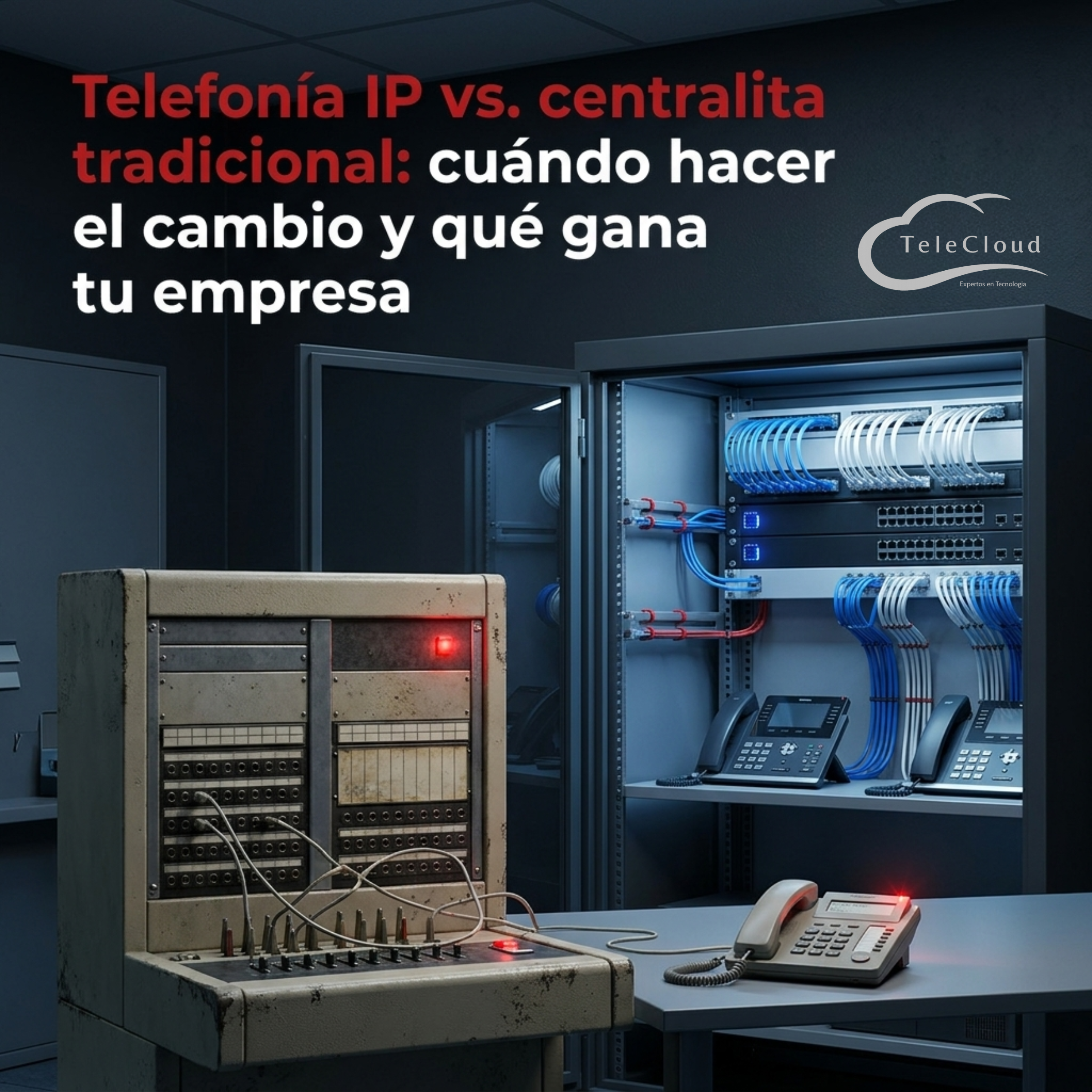
The PBX card fails on a Thursday and leaves the three areas that receive orders without a line. The vendor confirms that the model went out of production years ago and that getting the spare part will take two to three weeks, with luck, on the used equipment market. During that time, customers who dial the switchboard hear a tone nobody answers and end up calling a salesperson mobile number, if they happen to have it. Nobody can say how many calls were lost or whose they were, because that equipment never logged a single one. The cost of the spare part turned out to be insignificant next to what went out through that dead line.
The Signs That Your Switchboard Is Already an Operational Risk
Equipment Out of Production and Without Spare Parts
The most concrete sign is spare part availability. A traditional switchboard that went out of production lives off an inventory that is running out and a used equipment market without warranty. While it operates, that equipment works well and raises no alarm, which is why the replacement decision gets postponed year after year. The failure arrives without warning and the repair time stops being under your control, because it depends on someone having the part. An operation that receives orders by phone is accepting a risk whose duration it cannot estimate.
Every New Branch Becomes a Project
In a traditional scheme, adding a branch means its own switchboard, its contracted lines and its maintenance, and calls between sites are charged as external calls. The company ends up administering several different pieces of equipment, with separate vendors and contracts, and without a way to transfer a call between sites naturally. When the operation grows or opens plants, that model multiplies cost and complexity with each opening. Connectivity between sites stops being a telephony matter and becomes a network architecture matter.
You Cannot Answer How Many Calls Were Lost Yesterday
The limit that costs the most and is noticed the least is the absence of information. A traditional switchboard connects calls and rarely records what happened to them. Your company cannot know how many calls came in, how many were answered, how long each customer waited before hanging up, or during which hours service becomes saturated. Each of those unanswered calls is a commercial opportunity that left without a trace, which is why the problem never reaches the board with a figure to support it.
What Changes in Practice With IP Telephony
A Single Infrastructure for Voice and Data
IP telephony carries voice over the same data network that already operates in your company, which removes dedicated lines and specific switching hardware. That change has one condition worth stating clearly: call quality now depends on your network design. An implementation without voice traffic prioritization and without adequate sizing produces dropped calls and delayed audio, which is the reason some companies associate IP telephony with poor quality. In those cases the problem lives in the network and not in the technology.
Sites Connected as a Single Operation
With IP telephony, extensions stop being tied to a building. Branches, plants and field personnel belong to the same numbering plan, calls between sites travel over the network without long distance charges, and a person keeps their extension wherever they are. Opening a branch no longer requires a new switchboard and is resolved by configuring extensions over the data link. For companies with distributed operations or expanding through nearshoring, that change removes an entire project with each opening.
Service Becomes Measurable
The fundamental change for management is that telephony starts producing information. The system records calls received, answered and abandoned, waiting time, and distribution by hour and by area. With that data, decisions previously made by perception become verifiable: how many people are needed during peak hours, which area loses calls, and whether the customer complaining about delays is right. Telephony stops being an infrastructure expense and starts providing evidence about the quality of commercial service.
When to Make the Change and What to Review First
The Natural Moment for the Decision
There are four moments where the change is clearly justified: when the current equipment runs out of available spare parts, when the company opens or plans to open sites, when the contract renewal with the vendor is near, and when the operation needs to measure telephone service. Outside those moments, a traditional switchboard in good condition can keep operating. The decision worth avoiding is renewing a contract for another five years on obsolete equipment, because it freezes the problem and moves the failure to a moment nobody chose.
What You Should Review Before Migrating
Before a migration it is worth reviewing three fronts. The first is your data network, which will now carry voice and needs capacity, traffic prioritization and power backup at its critical points, because a power outage that previously left the phone line alive now also silences the phone. The second is continuity during the transition, which is resolved with a phased migration where both systems coexist while each area is moved. The third is what information you want to obtain from the system, because that defines the configuration from the start instead of rebuilding it later.
At TeleCloud we implement IP telephony and contact center solutions for companies in manufacturing, banking, government, hospitals, hotels and education, with more than twenty years of experience, Cisco, Fortinet, Avaya and Huawei certifications, and nationwide coverage from our base in Querétaro. We design the network that will carry the voice and the phased migration so your operation does not stop during the change, with a documented SLA and certified support. Learn about our approach at https://telecloud.com.mx
Frequently asked questions
Does IP telephony have worse audio quality than a traditional line?
Quality depends on the design of the network that carries the voice. With sufficient capacity, voice traffic prioritization and adequate equipment, quality is stable. The dropped calls and delayed audio some companies experienced come from implementations where voice competed with the rest of the traffic without any priority.
What happens to my telephony if the power goes out or the link fails?
This is the point most worth addressing in the design. Voice now depends on the network and on power, so critical points require UPS backup and the link should be backed up with an alternate path. With those two elements resolved, availability exceeds that of the traditional scheme, which also goes down when its hardware fails and additionally takes weeks to repair.
Can I keep my current phone numbers?
Yes. Numbers are ported to the new service and your customers keep dialing the same. Porting is planned within the project and executed in coordination with the phased migration to avoid interruptions in call reception.
Do you need a network diagnosis?
The TeleCloud team evaluates your current infrastructure and proposes solutions adapted to your industrial operation.
Schedule free diagnosis